


Thailand is one of the first places Chinese families mention when they talk about moving abroad. Bangkok is only a few hours’ flight from Beijing, Shanghai, Guangzhou, Kunming or Chengdu, the climate is warm, the food and Buddhist culture feel familiar, and everyday costs are moderate. Since the China–Thailand mutual visa exemption agreement took effect on 1 March 2024, many people go first as visitors and decide later whether to stay.
A great holiday destination is not automatically a good place to live, though. Thailand restricts long-term stays, employment and land ownership for foreigners, and in 2026 it tightened both its unilateral visa exemption and the Destination Thailand Visa (DTV). This guide looks at Thailand from the point of view of a mainland Chinese passport holder: culture, economy and jobs, cost of living, healthcare, the Chinese community, visa routes and safety, so you can decide whether moving to Thailand suits you and your family.
Why Thailand
For people from China the appeal comes down to three things. First, proximity: trips home are easy and the time difference is just one hour. Second, manageable costs: Numbeo’s October 2026 data puts a single person’s monthly spending in Bangkok, excluding rent, at about 23,600 baht. Third, choice of visas: from the 30-day visa exemption and tourist visas to the DTV (up to 180 days per entry), the 10-year Long-Term Resident (LTR) visa and the paid Thailand Privilege membership, there is a route for most ages and budgets.
According to civil registration data from the Ministry of Interior, Thailand had 65,809,011 registered residents on 31 December 2025, including about 988,600 non-Thai residents. The population fell by roughly 142,000 in a year and is ageing quickly. The World Bank, which counts residents differently, estimates 71.6 million for 2025, so always state which figure you use.
Culture and etiquette
China’s Ministry of Foreign Affairs country profile notes that over 90% of Thais are Buddhist and about 5% Muslim. In temples, cover your shoulders and knees and take off your shoes. Never touch someone’s head or point at people or things with your feet, and women should avoid physical contact with monks.
The monarchy holds a special place in Thai society. Section 112 of the Criminal Code punishes insulting the monarchy severely, and sharing or commenting on royal topics online can also break the law. Audiences stand when the royal anthem plays before films.
Thais value calm, face-saving communication; raising your voice at a government counter usually backfires. Thai is the national language. English works in Bangkok business settings, but in provincial towns a few words of Thai make renting, seeing a doctor and dealing with officials much easier. See our Thai language guide.
Economy and jobs
Thailand’s National Economic and Social Development Council (NESDC) reported in February 2026 that GDP grew 2.4% in 2025, ahead of expectations, and forecast about 2.0% for 2026 (range 1.5–2.5%). Tourism, car and electronics manufacturing, e-commerce and logistics drive growth. China is the largest source of visitors, with about 4.47 million arrivals in 2025.
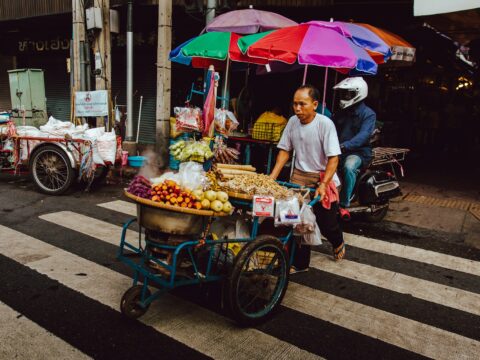
To work legally, a foreigner normally needs a Non-Immigrant B visa and then a work permit arranged with the employer. Under the Emergency Decree on Foreigners’ Working Management, the Ministry of Labour reserves certain occupations for Thais; a list published in June 2026 names 10 jobs that are strictly prohibited for foreigners, including street vending, Thai massage, beauty and hairdressing, driving, tour guiding, legal services and security work. Working while on a tourist visa or visa exemption is illegal.
On pay, Bangkok’s statutory minimum wage has been 400 baht a day since 1 July 2025. For employees in the social security system, the contribution ceiling for 2026–2028 is a monthly wage of 17,500 baht, with employer and employee each paying 5%, a maximum of 875 baht a month.
If you plan to start a company, note that Thailand limits foreign shareholding and market access in many sectors, and using Thai nominees to get around these limits is illegal. Company registration and BOI incentives are covered in our guide to doing business in Thailand.
Cost of living
Including rent, a single person in Bangkok spends roughly 35,000 baht a month living outside the centre and about 46,000 baht in the centre. A meal at an inexpensive restaurant costs about 100 baht and a mobile plan with 10GB+ data about 500 baht a month. Rents in Chiang Mai or Hua Hin are usually lower than in Bangkok, but international schools, private hospitals and imported food are not cheap, so families should budget separately. City-by-city figures are in our Thailand cost of living guide.
Healthcare
Thailand’s Universal Coverage Scheme (the “30-baht scheme”) is mainly for Thai citizens. Foreigners usually use private hospitals or join social security through their employer. Bangkok, Phuket and Chiang Mai have many private hospitals, some with international patient departments; care is good but expensive, and without insurance a single hospital stay can cost tens or even hundreds of thousands of baht.
Employees with a work permit who pay into social security can be treated at their registered hospital. Applicants for the one-year O-A retirement visa must show health insurance with cover of at least 3 million baht (or US$100,000), according to Thai embassies. Long-term residents should consider local or international health insurance; see our Thailand insurance guide.
Get a full health check in China before leaving and bring your regular medicines with English prescriptions and a medical summary. Some medicines are controlled in Thailand, so check ingredients in advance.
The Chinese community
Chinese migration to Thailand goes back centuries, mostly from Chaoshan, with Hakka, Hainanese, Hokkien and Cantonese communities too. Many Thai Chinese are fully integrated, with Thai names and Thai as their first language. Thailand publishes no official count by ethnicity; common estimates put people of Chinese descent at over a tenth of the population, but figures vary widely.
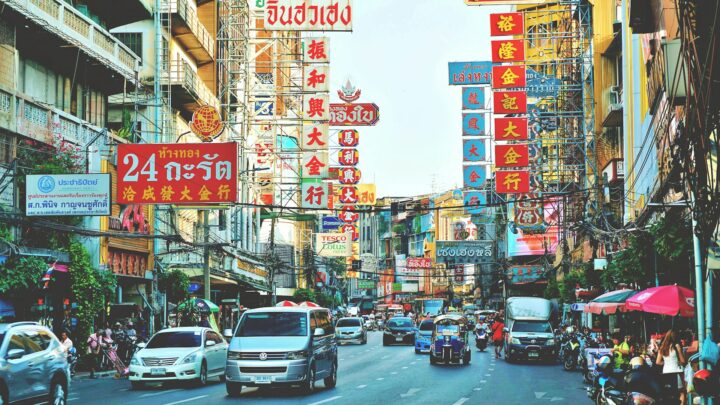
Yaowarat Road is Bangkok’s traditional Chinatown. Over the past decade, newer arrivals from mainland China, business people and students have clustered around Huai Khwang and Ratchada in Bangkok, as well as in Chiang Mai and Phuket. Long-established clan and hometown associations and chambers of commerce sit alongside Chinese-language newspapers and busy WeChat groups. See our Chinese community in Thailand guide.
The Chinese Embassy is in Bangkok (th.china-embassy.gov.cn); passport renewals and notarisation can be booked through the China Consular app.
Visa and residence routes at a glance
| Route | Who it suits | Stay | Key conditions (October 2026) |
|---|---|---|---|
| Visa exemption | Tourism, family visits, scouting trips | Up to 30 days per entry, 90 days per 180 | No work or study; complete the Thailand Digital Arrival Card (TDAC) before arrival |
| Tourist visa (TR) | Visitors who want a longer stay | Up to 60 days per entry, extendable | Apply online through the Thai e-Visa website |
| Destination Thailand Visa (DTV) | Remote workers, freelancers, Muay Thai or cooking students | 5 years, multiple entry, up to 180 days per entry | 500,000 baht in funds; police clearance required from 31 August 2026 |
| Non-B + work permit | Employees of Thai companies | Usually renewed yearly | Employer sponsorship; job not on the reserved list |
| Non-ED education visa | University and language school students | Length of course | Admission and sponsorship by the school |
| O / O-A retirement visa | People aged 50+ | 1 year, renewable | Proof of funds; O-A requires health insurance |
| Long-Term Resident (LTR) | High earners, wealthy individuals, wealthy pensioners | 10 years (5+5) | e.g. US$1m in assets plus US$500,000 invested in Thailand |
| Thailand Privilege | Those with a budget who want minimal paperwork | 5–20 years | Membership fee 650,000–5,000,000 baht |
Documents, fees, how to apply from China and the 2025–2026 rule changes are covered in our Thailand visa guide.
Before committing to a long stay, sort out matters at home: enough passport validity, the police clearance certificate needed for visas such as the DTV, notarisation and authentication of degree and marriage documents, your personal foreign exchange quota, and whether to keep your social insurance and hukou. Most of these can only be done in China; arranging them from abroad means flying back or appointing someone. See our checklist for leaving China.
Safety
Thailand is generally welcoming to visitors, but road accidents (especially on motorbikes), tourist scams and theft are common. Drug laws are strict: never carry bags or parcels for strangers.
In June 2026 the Chinese Embassy in Thailand warned that Chinese citizens who have visited border areas such as Tak province, or whose travel patterns look unusual, may face extra checks or be refused entry. Be wary of “high-paid jobs in Thailand”, “free flights and lodging” or “investment tours”: such offers are often used to traffic people to scam compounds on the Myanmar border.
Thailand regulates gambling strictly, and both online gambling and illegal casinos carry enforcement risks; “free hospitality” at some venues can be a trap. Whether local gambling is legal and how the rules affect Chinese citizens is explained in our Thailand gambling laws guide. For city-by-city safety advice see our Thailand safety guide.
Pros and cons
Pros
- Close to China with many flights and a one-hour time difference
- 30-day visa exemption and a wide choice of long-stay visas
- Manageable living costs and good private healthcare
- Established Chinese community and familiar food culture
Cons
- Limits on foreign workers, with 10 occupations explicitly banned
- Foreigners generally cannot own land; foreign shareholding is restricted
- Slow growth, about 2% forecast for 2026
- Visa rules changed several times in 2026 and need watching
- Permanent residence and citizenship are hard to obtain
If you are weighing Thailand against other options in the region, compare our Malaysia guide and the Asia overview.
FAQ
Do Chinese citizens need a visa for Thailand?
For tourism or family visits, ordinary passport holders can enter visa-free for up to 30 days per entry and no more than 90 days in any 180 days. Thailand ended its unilateral 60-day exemption for 93 countries and territories on 15 September 2026, but the China–Thailand mutual exemption agreement is not affected. Work, study or stays longer than 30 days require the right visa in advance.
Is moving to Thailand a good idea?
It suits people who value climate, pace of life and being close to home, especially remote workers, retirees and families with savings. If you need a local job or want to run a small business, check the occupation and foreign-ownership rules first.
Can foreigners buy property in Thailand?
Foreigners generally cannot own land in their own name. The usual options are buying a condominium unit (subject to a foreign ownership quota) or a long lease. Moving purchase money out of China also raises foreign exchange quota issues; see our Thailand property guide and guide to buying and sending foreign currency.
Can I get permanent residence or citizenship in Thailand?
Thailand has a permanent residence system, but places are few and checks are strict, so most Chinese residents rely on renewable long-stay visas (LTR, Privilege or retirement). China does not recognise dual nationality, so naturalising in Thailand means losing Chinese nationality automatically.
Sources
- 新华网:中国公民赴泰国仍可享受免签待遇(2026年9月2日) (accessed October 2026)
- 中国领事服务网:泰国入境须知 (accessed October 2026)
- 外交部:泰国国家概况 (accessed October 2026)
- Khaosod English: Thailand’s population shrinks down to 65.8 million (Department of Provincial Administration data, 27 Mar 2026) (accessed October 2026)
- Thailand Public Relations Department: Thailand exceeds targets with 2.4% GDP growth in 2025 (NESDC) (accessed October 2026)
- World Bank Open Data: Thailand (accessed October 2026)
- Numbeo: Cost of Living in Bangkok (updated 3 Oct 2026) (accessed October 2026)
- Nishimura & Asahi: Thailand minimum wage increase from 1 July 2025 (law firm) (accessed October 2026)
- HLB Thailand: Social security contribution changes for 2026 (advisory firm) (accessed October 2026)
- Asia News Network: Thailand lists 10 jobs foreigners cannot do (15 Jun 2026) (accessed October 2026)
- The Online Citizen: Chinese arrivals to Thailand in 2025 (Ministry of Tourism and Sports data, 17 Feb 2026) (accessed October 2026)
- 中国日报网:中国驻泰国使馆提醒谨慎前往泰缅边境地区(2026年6月24日) (accessed October 2026)
- Thailand Board of Investment: Long-Term Resident (LTR) Visa (accessed October 2026)
- Asia Lifestyle Magazine: Thailand DTV visa changes from 31 August 2026 (media) (accessed October 2026)
- Royal Thai Embassy Madrid: Health insurance requirements for Non-Immigrant O-A applicants (accessed October 2026)
- Thaiger: Thailand Privilege visa tiers and cost (updated 26 Aug 2026, media) (accessed October 2026)