




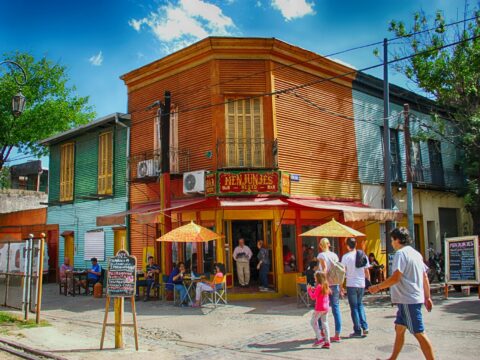
Argentina is South America’s second-largest country. It covers about a third of China’s land area but has only about 46 million people. The vast Pampas, European-style Buenos Aires, world-class beef and wine, and relatively high standards of education and healthcare set it apart in Latin America. For people from China there is another practical draw: the residence period needed for citizenship is among the shortest anywhere.
But Argentina is also a country of economic booms and busts. Years of high inflation, currency controls and policy reversals are risks every would-be migrant must face. This guide looks at Argentina from a Chinese perspective: culture and etiquette, economy and jobs, cost of living, healthcare, the Chinese community, visas and residence, safety, and the pros and cons of moving there. Figures carry sources and years; always check the latest official Argentine announcements.
Why Argentina: an overview
Argentina’s 2022 census counted 46.04 million people, with about 46.74 million estimated for 2025. The capital is Buenos Aires, whose metropolitan area holds roughly a third of the population. The official language is Spanish, the currency is the Argentine peso (ARS), and the time zone is UTC−3, 11 hours behind Beijing, with no daylight saving time.
Common reasons to move include a pace of life and culture closer to Europe’s, relatively solid public education and healthcare, and generous naturalisation rules: two years of continuous legal residence are enough to apply for citizenship. Travel is also easier than before: China has waived visas for Argentines since 1 June 2025 (currently until 31 December 2026), and Argentina waives visas for Chinese citizens who hold a valid US visa.
Culture and etiquette
- Greetings: Argentines greet with a single cheek kiss, and male friends often do too; a handshake is fine at a first meeting.
- Daily rhythm: dinner usually starts after 9 pm and restaurants are still busy at 10; the weekend asado (barbecue) is a key family and social event.
- Mate: friends share mate tea from a single gourd. Being offered it is a sign of trust; drink it all and hand it back to the person serving.
- Language: Argentine Spanish has a distinctive Rioplatense accent, uses “vos” instead of “tú” and pronounces “ll/y” like “sh”. Learning some Spanish before you go makes life much easier; English is limited outside the big cities.
- Topics: football and food are safe; the Falklands/Malvinas, politics and economic crises are sensitive, so avoid volunteering opinions early on.
Economy and jobs
Argentina’s economy has long swung between crisis and recovery. Since taking office in December 2023, President Milei’s government has slashed public spending and pushed market reforms. According to the World Bank’s September 2026 overview, monthly inflation has fallen from over 20% to about 2.5–3%, GDP grew 4.4% in 2025 and is forecast to grow about 3.6% in 2026, although disinflation has slowed somewhat since late 2025.
The most important thing for newcomers to understand is the peso–dollar relationship. For years Argentina had strict currency controls and parallel exchange rates; large transactions such as property purchases are customarily priced in US dollars, while local salaries are paid in pesos. According to Numbeo (October 2026), the average net monthly salary in Buenos Aires is about US$938, far below Europe or North America.
Retail is the most visible Chinese business sector: neighbourhood supermarkets known locally as “supermercados chinos” are everywhere in Buenos Aires. Others work in restaurants, import/export, Chinese companies (energy, mining, infrastructure, cars) and translation or professional services. Working legally requires the right residence status; working after entering as a tourist or visa-free is illegal. For jobs and labour law, see our Argentina work and jobs guide, and for setting up a company, starting a business in Argentina.
Cost of living
A single person in Buenos Aires spends about US$893 a month before rent. With a one-bedroom flat outside the centre the total is about US$1,400; in popular areas such as Palermo or Recoleta it is US$1,650 or more. Rents in Córdoba, Mendoza and Rosario are noticeably lower.
Note that prices measured in dollars swing a lot. When the peso falls, foreigners holding dollars find Argentina “cheap”; when it strengthens, dollar costs rise quickly. Over the past two years Buenos Aires has stopped being “Latin America’s cheapest big city” in dollar terms. Beef, wine and local produce are relatively cheap, while imported electronics, cars and branded clothing cost much more than in China. For a fuller breakdown, see cost of living in Argentina.
Healthcare
Argentine healthcare has three parts: public hospitals, employment- and union-linked social health insurance (obras sociales), and private prepaid plans (prepagas). Public hospitals have long offered free care to everyone, and teaching hospitals are good, but waits are long and quality varies by region.
Things changed in 2025. According to the Argentine Embassy in China, under Emergency Decree 366/2025 (DNU 366/2025) foreigners entering Argentina must hold valid health insurance for their entire stay. Most long-term residents choose a private prepaid plan, with prices varying widely by age and coverage.
Buy travel or international health insurance that covers Argentina before you leave and carry the policy in English or Spanish. In Argentina, dial 107 for an ambulance, 911 for the police (Buenos Aires and elsewhere) and 100 for the fire brigade. For insurance advice, see our Argentina insurance guide.
Chinese community
Estimates of the Chinese community vary widely. The 2022 census counted 18,629 residents born in mainland China; the national registry RENAPER recorded 52,341 Chinese nationals in August 2023; academic and community estimates, which include naturalised citizens and descendants, are usually around 200,000.
Early migrants came mostly from Taiwan; from the 1990s Fujianese migrants became the core of the community, and more recently there are growing numbers of university-educated employees of Chinese companies and young professionals. Barrio Chino in Belgrano, Buenos Aires, is the community’s heart, with Chinese restaurants, supermarkets and a Buddhist temple; its Lunar New Year celebrations draw large local crowds every year.
The Chinese supermarket sector is highly competitive and has seen repeated robberies and extortion attempts in recent years. Newcomers entering the trade should learn the local labour, tax and consumer protection rules first. For associations, chambers of commerce and Chinese schools, see the Chinese community in Argentina.
Visa and residence routes at a glance
| Route | For whom | Main conditions (as of October 2026) |
|---|---|---|
| Visa waiver for US visa holders | Tourism, business | Valid US B1/B2, B2, J, B1, O, P, E or H-1B visa, or a US green card: 30 days visa-free |
| Consular tourist/business visa | Short-term visitors without a US visa | Apply at an Argentine mission in China |
| Temporary residence: migrant worker | People hired by an Argentine employer | Employment contract; employer helps obtain an entry permit |
| Temporary residence: rentista / pensionado | People with steady passive income or a pension | Monthly income of at least 5 times the minimum wage (c. ARS 1,956,000 in Oct 2026); rentista income must come from foreign assets and arrive through banks (initially 1 year, renewable) |
| Temporary residence: students, academics, scientists | Study, teaching, research | Letter from the institution |
| Family reunion | Relatives of Argentine citizens or residents | Proof of relationship (legalised and translated) |
| Permanent residence | Those with 3 years of temporary residence, among others | “Arraigo” conditions, or being the child of an Argentine |
Temporary residence lasts up to 3 years and comes with a temporary national ID (DNI) for living and working. Non-Mercosur nationals with 3 years of temporary residence can apply for permanent residence. For the exact visa-waiver conditions, check the Argentine Embassy in China’s visas and exemptions page. For documents, fees and where to apply, see our Argentina visa guide.
Safety
Compared with most big Latin American cities, Buenos Aires has relatively low levels of violent crime, but pickpocketing, phone snatching (especially by thieves on motorbikes) and burglary are common, and cities such as Rosario have seen drug-related violence in the past.
- Don’t hold your phone in your hand on the street, on the metro or on buses;
- avoid walking alone on quiet streets at night and use licensed ride-hailing;
- watch out for distraction thefts such as “someone spills something on you and a helpful stranger appears”;
- Chinese-run shops should install CCTV, keep little cash on site, and report any extortion to the police and the Chinese Embassy in Argentina.
If you are robbed, do not resist. Chinese citizens can call the Ministry of Foreign Affairs 24-hour consular protection hotline +86-10-12308.
Gambling in Argentina is regulated separately by each province, and Buenos Aires and other cities have licensed casinos. For whether local gambling is legal and how it affects Chinese citizens, see gambling laws in Argentina.
Pros and cons
Pros
- Citizenship after just 2 years of continuous legal residence; Argentina accepts multiple nationality
- European-style city life with rich culture, arts and food
- Relatively solid public education and healthcare
- Many residence categories, with online applications through the immigration office
- Diverse climate, from subtropics to glaciers
Cons
- Volatile economy with persistent inflation and currency risk
- Low local wages, paid in pesos
- Spanish is a must and bureaucracy is slow
- Far from China; a one-way trip usually takes over 30 hours
- Frequent policy changes require constant attention to immigration rules
FAQ
What do I need to emigrate to Argentina?
Common routes are employment, temporary residence based on a stable income or pension, study, or family reunion. You usually need a valid passport, birth certificate, police clearance certificate (apostilled and translated into Spanish) and proof of an address in Argentina, and you can apply online through the immigration office’s RaDEX system.
Does Argentine citizenship really take only two years?
According to the Argentine government’s naturalisation page, applicants must be over 18, already hold temporary or permanent residence, have lived in Argentina continuously and legally for the 2 years before applying without leaving the country, and prove a lawful occupation or means of support. Naturalising means automatically losing Chinese nationality; see dual nationality and Chinese law.
What should I sort out first after arriving?
Once you have residence, collect your temporary DNI from the immigration office, then get a tax number (CUIL/CUIT) from the tax authority. Only then can you easily open a bank account, sign a lease and get a phone contract. Argentine banks ask foreigners for a lot of paperwork, and rules on international transfers and currency exchange change often; see banking in Argentina. We report changes to currency and immigration rules in our news section.
Is moving to Argentina a good idea?
If you value quality of life, culture and a fast path to citizenship, and your income does not depend on the local market (for example remote work or foreign income), Argentina is very attractive. If you need to earn pesos locally and carry the currency risk, be prepared. To compare within South America, see our Brazil guide and the South America overview.
Sources
- Wikipedia – Argentina (census 2022 and 2025 population estimate; secondary source) (accessed October 2026)
- World Bank – Argentina Overview (updated Sept 2026) (accessed October 2026)
- Numbeo – Cost of Living in Buenos Aires (updated 7 Oct 2026) (accessed October 2026)
- Wikipedia – Inmigración china en Argentina (secondary source, cites INDEC, RENAPER and academic estimates) (accessed October 2026)
- Embajada de la República Argentina en China – Visas y exenciones (updated 16 Mar 2026) (accessed October 2026)
- Allende & Brea – Nueva resolución flexibiliza el ingreso de turistas y empresarios de China (law firm, July 2025) (accessed October 2026)
- Argentina.gob.ar – Migraciones: Residencia temporaria (accessed October 2026)
- Argentina.gob.ar – Migraciones: Residencia permanente (accessed October 2026)
- Argentina.gob.ar – Obtener la ciudadanía argentina por naturalización (accessed October 2026)
- Argentina.gob.ar – Cuadro de tasas migratorias (accessed October 2026)
- Argentina.gob.ar – Obtener una residencia temporaria como rentista (accessed October 2026)
- Argentina.gob.ar – Obtener una residencia temporaria como pensionado (accessed October 2026)
- Consejo Nacional del Empleo, la Productividad y el SMVM – Resolución 4/2026 (1 Sept 2026), via Colegio de Escribanos (accessed October 2026)