The short answer: if you hold a mid- to long-term visa and will live in Japan for more than three months, you must join the public health insurance system. At the counter you normally pay 30% of the bill, insurance covers the rest, and your monthly out-of-pocket spending is capped under the High-Cost Medical Expense Benefit (kogaku ryoyohi). Employees join Employees’ Health Insurance (kenko hoken, “shaho”) through their company. Students, the self-employed, Business Manager visa holders and people without a job join National Health Insurance (kokumin kenko hoken, “kokuho”) at their local city or ward office. Tourists and short-term visitors cannot join and must pay in full or rely on travel medical insurance.
Unlike in China, people in Japan do not queue for specialist slots at big hospitals. You start at a local clinic, and the doctor refers you to a hospital when needed. Turning up at a large hospital without a referral letter costs an extra 7,000 yen (about 298 yuan) or more. As of October 2026 the old paper insurance cards can no longer be used: you show your My Number card registered as a health insurance card, or a “certificate of eligibility” (shikaku kakuninsho). This guide covers how the system works, what it costs, what changed in 2026, where to find Chinese-language help, and the emergency numbers. Conversions use the CFETS central parity of 12 October 2026: 100 yen = 4.2506 yuan.
How Japanese healthcare works: universal insurance and free choice
Japan has universal coverage. Everyone who lives in the country legally must belong to a public insurance scheme, and can then go to any insurance-registered clinic or hospital they like. Clinics, university hospitals and private hospitals all charge the same nationally set fee schedule, so a given test costs about the same in Tokyo as in the countryside. That is very different from China, where prices depend on the hospital’s grade and treatment outside your home province needs prior registration.
Healthcare in Japan is expensive. MHLW figures put national medical care expenditure for FY2023 at 48.09 trillion yen, or about 386,700 yen per person (about 16,400 yuan). Care for people aged 75 and over took up 35.8% of the total. That is the background to the government’s recent changes to out-of-pocket caps and its tighter handling of unpaid premiums by foreign residents. If you plan to live and work in Japan long-term, start with our Japan overview for visas, living costs and more.
Who can join, and which scheme?
According to published ward-office guidance, foreign nationals staying in Japan for more than three months who are registered as residents must join National Health Insurance, unless they are already covered through an employer. Short-term visitors (tourism, business visits) cannot join. Nor can people on a “Designated Activities” status granted for medical treatment, sightseeing or recuperation. You must enrol within 14 days of moving in or leaving a job. If you enrol late, you still owe premiums for the months you missed.
| Item | Employees’ Health Insurance (shaho) | National Health Insurance (kokuho) |
|---|---|---|
| Who | Company employees (common for Engineer/Specialist in Humanities/International Services, Highly Skilled Professional, etc.) | Students, self-employed, Business Manager visa holders, the unemployed, people not covered as dependants |
| Where to enrol | Your employer handles it (Kyokai Kenpo or a company health insurance society) | Your city or ward office, within 14 days of moving in or leaving a job |
| Premiums | Based on salary, split between employer and employee | Based on the previous year’s income and household size, and set by each municipality |
| Family | An eligible spouse and children can be covered as dependants at no extra cost | Each person is insured separately and premiums depend on household size |
| New in 2026 | Paper cards have expired. Use a My Number health card or a certificate of eligibility | From FY2026, some municipalities may ask new arrivals from abroad to pay the first year’s premiums in advance |
If you come to Japan for a job, your company usually enrols you in shaho once you have your residence card and resident registration. For employment rules, see our guide to working in Japan. If you arrive through an agent or a school, check who is responsible for your insurance so you are never left without cover.
What it costs: co-payments and the high-cost cap
Once you are insured, the share you pay at the counter depends on your age. As of October 2026, MHLW lists the following rates:
| Age | Co-payment |
|---|---|
| Under 6 (before school) | 20% (many local governments add child medical subsidies, so it can be lower or free) |
| 6–69 | 30% |
| 70–74 | 20% (30% for those with income comparable to working age) |
| 75 and over | 10% (20% above a certain income, 30% for working-age-level income) |
The High-Cost Medical Expense Benefit is what really protects you. Anything you pay above your monthly limit is refunded. If you apply in advance for a “limit certificate” or use a My Number health card, the hospital charges only up to the cap. From 1 August 2026, the monthly caps for people under 70 rose by roughly 6–7% across income bands, and an annual cap was introduced for the first time.
Example: an employee earning 5 million yen a year spends a month in hospital, and the total bill is 1,000,000 yen (about 42,506 yuan). At 30% they would owe 300,000 yen (about 12,752 yuan). With the cap they pay 85,800 + (1,000,000 − 286,000) × 1% = 92,940 yen (about 3,951 yuan). The new annual cap for this band is 530,000 yen (about 22,528 yuan), which matters a lot to families paying for long-term treatment such as cancer care. MHLW materials say a second stage from August 2027 will split the income bands further and raise caps for middle and higher earners; the amounts have not yet been announced, so check the official figures when it takes effect. Hospital meals, the surcharge for a private room (sagaku bed fee) and non-insured treatment are not covered and do not count toward the cap. You can fill that gap with private medical insurance in Japan.
Seeing a doctor, step by step: from clinic to pharmacy
- Decide how urgent it isCall 119 if life is at risk. If you are unsure whether you need an ambulance, call #7119 where available
- Start at a clinicFor colds, fever, skin problems and similar, go to a local internal-medicine or dermatology clinic. Most take bookings online or by phone
- Bring your documentsYour My Number health card or certificate of eligibility, plus your residence card. On your first visit you fill in a medical questionnaire (monshinhyo)
- Pay at the counterYou pay your co-payment share. Many clinics still take cash only, so carry yen
- Get a referralIf you need a specialist, the doctor writes a referral letter (shokaijo) to a larger hospital
- Collect your medicineTake the prescription to a dispensing pharmacy (chozai yakkyoku) outside the clinic, where you pay the same co-payment share
If you go to a large hospital without a referral (for example a regional medical support hospital with 200 or more general beds), you pay a “sentei ryoyohi” surcharge on top of the medical fees: at least 7,000 yen (about 298 yuan) for a first visit and at least 3,000 yen (about 128 yuan) for a follow-up. For dental care the minimums are 5,000 and 1,900 yen. Some prefectures charge the same fee at designated hospitals when an ambulance patient turns out not to need admission. In Ibaraki, for example, this has applied since December 2024, at 2,200 to 13,200 yen depending on the hospital. The ambulance ride itself is still free.
Prescription drugs in Japan must be collected from a dispensing pharmacy with a prescription. The pharmacist gives you an “okusuri techo” medication notebook. Show it whenever you see a new doctor so you are not given duplicate medicines. Everyday cold and pain medicines are sold at drugstores, but some prescription drugs that are common in China are controlled in Japan. If you take medicine long-term, ask your doctor in China for English medical records and drug information before you leave. See medical check-ups and records before leaving China.
Public vs private hospitals
China’s system is built around large public hospitals. In Japan, most hospitals are private. At the end of July 2026, 5,551 of Japan’s 7,942 hospitals (about 70%) were run by medical corporations. Municipalities ran 574, national universities 47 and the Japanese Red Cross 90. Private does not mean more expensive: at any insurance-registered hospital, insured treatment costs the same as at a public hospital, and you pay the same co-payment rate.
Real price differences appear in non-insured care (jiyu shinryo): cosmetic medicine, some health check-ups, unapproved drugs, and some international clinics serving patients fully in English or Chinese. These providers set their own prices and you cannot use insurance. Asking “hoken shinryo desu ka?” (is this insured treatment?) before you are treated avoids surprise bills. University hospitals and large public hospitals expect referrals and focus on complex or serious cases. For everyday illnesses a clinic is fastest.
2026 changes to watch: cards, advance premiums and arrears
- Paper cards phased out: Employees’ old paper cards expired on 1 December 2025, and kokuho cards expired earlier. A transitional measure ended at the end of March 2026. If you do not have a My Number health card, you receive a certificate of eligibility instead. In Meguro Ward, for example, it is valid until 31 July 2027 at the latest, or until your residence period ends if that is sooner.
- Advance first-year premiums: On 29 October 2025, MHLW issued a model ordinance allowing municipalities, from FY2026, to require people arriving from abroad for the first time to pay kokuho premiums in advance. Each municipality decides whether to do this, so ask your ward office when you register.
- Arrears and your visa: Cabinet Secretariat materials show that, as of end-2024, foreign residents’ kokuho collection rate was about 63% in roughly 150 surveyed municipalities, against 93% for all residents. Some municipalities already report arrears more than one year overdue to immigration. Under the government timetable, data links between municipalities and the Immigration Services Agency are due to start in June 2027. After that, unpaid health insurance and pension contributions may directly affect visa renewals and changes of status.
- Unpaid bills as a visitor: MHLW warns that leaving medical bills unpaid in Japan may lead to stricter immigration checks on future visits.
Before renewing your visa, keep your kokuho payment slips and pension payment records. When you move, file your moving-out and moving-in notices promptly so you are not billed twice or miss a payment. For renewals and visa types, see our Japan visa guide.
Chinese-speaking doctors and multilingual help
Cities with large Chinese communities, such as Tokyo and Osaka, have Chinese-speaking doctors and clinics, but the lists change often, so we do not recommend specific providers. Official channels are the most reliable way to find one:
- JNTO medical institution search: the Japan National Tourism Organization’s site lets you search by area, language (including Chinese) and specialty. It draws on prefectural lists of hospitals that accept foreign patients, compiled by MHLW and the Japan Tourism Agency (updated June 2026, partly revised in September). Start from the MHLW information page.
- Japan Visitor Hotline: 050-3816-2787, 24 hours a day, every day, in Chinese, English and Korean. It helps with illness, accidents and disasters.
- Tokyo “Himawari” medical information service: 03-5285-8181, daily 9:00–20:00. You can ask about nearby hospitals in Chinese.
- AMDA International Medical Information Center: 03-6233-9266, multilingual medical advice. According to Chuo City, Chinese is available on Tuesdays and Thursdays, 10:00–16:00. Please check again before calling.
Many hospitals also offer phone or tablet interpreting. When booking, ask “Chugokugo no tsuyaku wa arimasu ka?” (is a Chinese interpreter available?). If you are staying long-term, learning some basic medical Japanese is very useful.
Emergency numbers: 119 and #7119
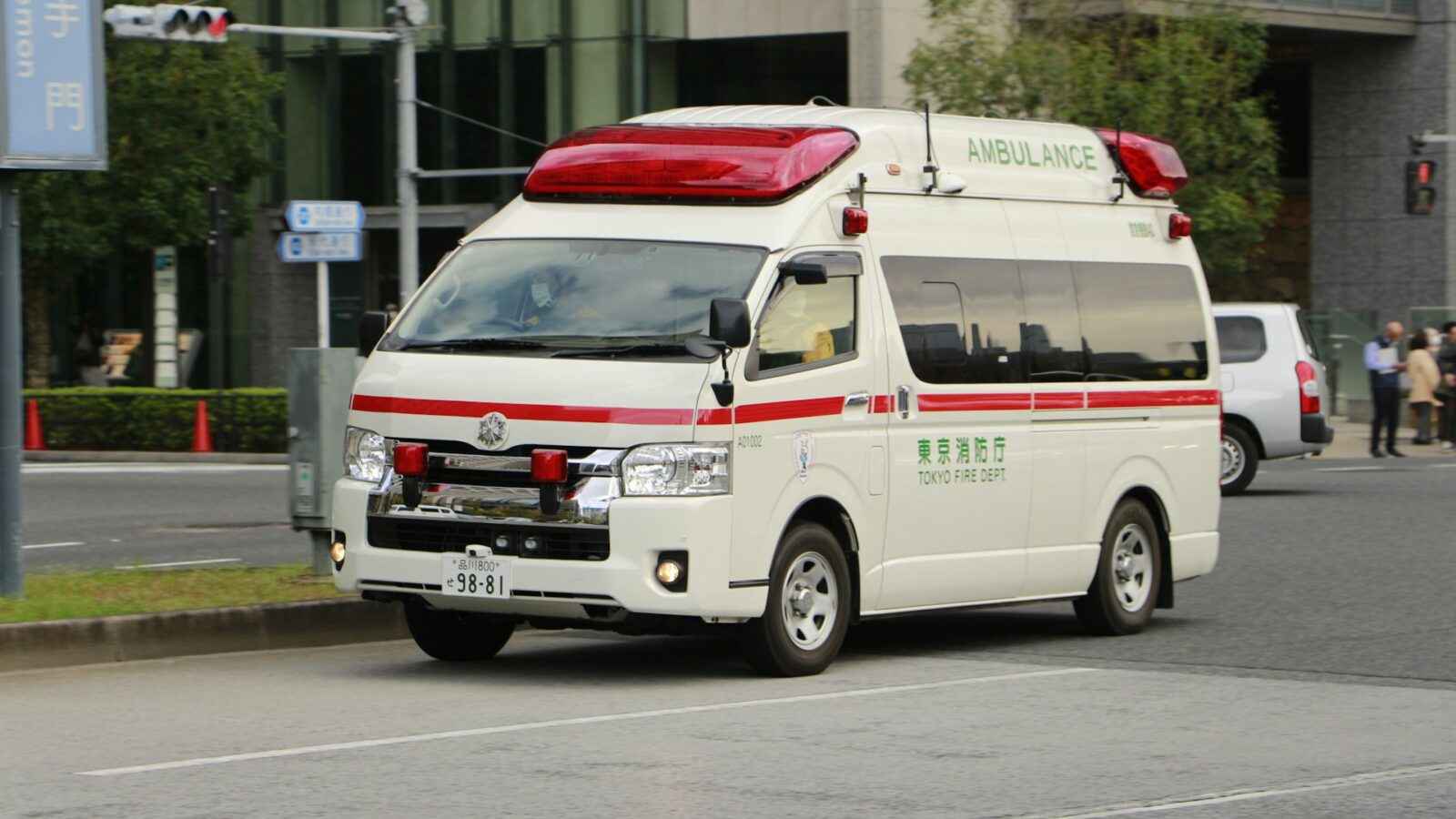
In Japan, 119 is the number for fire and ambulance, and the ambulance is free. Call 110 for the police. When you dial 119, say “kyukyu desu” (it’s a medical emergency) first, then give your address. As of October 2025, the #7119 emergency advice line runs in 40 areas covering about 85.7% of the population. Medical staff, usually available 24 hours, help you decide whether to call an ambulance or see a doctor right away. If #7119 does not connect from your phone, look up your prefecture’s standard number. For safety and disaster preparedness, see our Japan safety guide.
Compared with healthcare in China
| Item | China (2025) | Japan |
|---|---|---|
| Health spending per person | Total health expenditure per capita: 6,637.9 yuan | National medical expenditure per capita: about 386,700 yen (about 16,437 yuan, FY2023) |
| Out-of-pocket burden | Personal spending: 27.1% of total health expenditure | Usually 30% at the counter, with monthly and annual caps |
| Number of hospitals | 38,710 (2024) | 7,942 (end of July 2026), plus about 105,700 general clinics |
| How people seek care | Going straight to a big hospital is common | Clinic first, then referral. A big hospital without a referral adds at least 7,000 yen |
The two countries measure these figures differently (China’s total health expenditure has a broader scope), so treat the comparison as a rough guide. Overall, Japan’s insurance cover is broader and its prices are more transparent. Big hospitals still have waits, specialist appointments take time, and consultations are mostly in Japanese. For what happens to your Chinese medical insurance after you leave, see hukou and social security after leaving China. For overall living costs, see cost of living in Japan. To compare with a neighbouring country, see healthcare in South Korea.
FAQ
What if I fall ill in Japan on a tourist or short business visa?
Short-term visitors cannot join Japan’s public insurance and must pay the full cost. Some hospitals charge uninsured patients non-insured rates. MHLW advises buying travel insurance with medical cover before you travel. Unpaid medical bills may lead to stricter immigration checks on later visits.
Do international students have to join National Health Insurance?
Yes. Students staying more than three months who are registered as residents must join kokuho at their ward office within 14 days of moving in, and they pay 30% like everyone else. Some schools also offer student mutual-aid insurance that refunds part of the co-payment.
Can I find a Chinese-speaking doctor in Japan?
Yes, but you have to look. Use the JNTO search and filter by Chinese, or call Himawari or the Japan Visitor Hotline. Big cities also have Chinese-language clinics. Before you choose one, check whether it offers insured treatment.
Will unpaid kokuho premiums affect my visa renewal?
They already can. Some municipalities share long-term arrears with immigration, and the government plans to link the data nationwide from June 2027. If you are struggling to pay, ask your ward office early about instalments or reductions instead of leaving the bills unpaid.
Sources
- MHLW: Revision of the High-Cost Medical Expense Benefit (caps from August 2026) (accessed October 2026)
- Suginami City: High-Cost Medical Expense Benefit revised from 1 August 2026 (accessed October 2026)
- MHLW: Medical Insurance Subcommittee reference material (11 Sep 2026, co-payment rates) (accessed October 2026)
- Meguro City: National Health Insurance enrolment for foreign nationals (accessed October 2026)
- Cabinet Secretariat: Health insurance and foreign residents (symbiotic society materials) (accessed October 2026)
- MHLW: Measures on foreign residents and health insurance (timeline) (accessed October 2026)
- MHLW notice: advance payment of first-year NHI premiums for new arrivals (29 Oct 2025) (accessed October 2026)
- Law-office commentary: NHI payment and residence reviews (updated Sep 2026, unofficial) (accessed October 2026)
- Sakigake (Kyodo): Old paper health insurance cards expire on 1 December (accessed October 2026)
- Hyogo Prefecture: Sentei ryoyohi (surcharge for visits without referral) (accessed October 2026)
- Ibaraki Prefecture: Sentei ryoyohi charged after non-urgent ambulance transport (accessed October 2026)
- Fire and Disaster Management Agency: #7119 emergency consultation service coverage (accessed October 2026)
- Chuo City, Tokyo: Medical consultation services (AMDA, Himawari) (accessed October 2026)
- Japan National Tourism Organization (JNTO): Japan Visitor Hotline (accessed October 2026)
- MHLW: List of medical institutions accepting foreign patients (accessed October 2026)
- MHLW: Notice to visitors to Japan on buying medical insurance (accessed October 2026)
- MHLW: Survey of Medical Institutions (preliminary, end of July 2026) (accessed October 2026)
- MHLW: Estimates of National Medical Care Expenditure, FY2023 (accessed October 2026)
- Xinhua: Key figures of NHC 2024 Statistical Bulletin on Health Development (accessed October 2026)
- Xinhua: RMB central parity rates on 12 October 2026 (CFETS) (accessed October 2026)
- Xinhua: NHC 2025 Statistical Bulletin on Health Development (28 Aug 2026) (accessed October 2026)
- Minato City: high-cost medical expense caps from August 2026 (accessed October 2026)