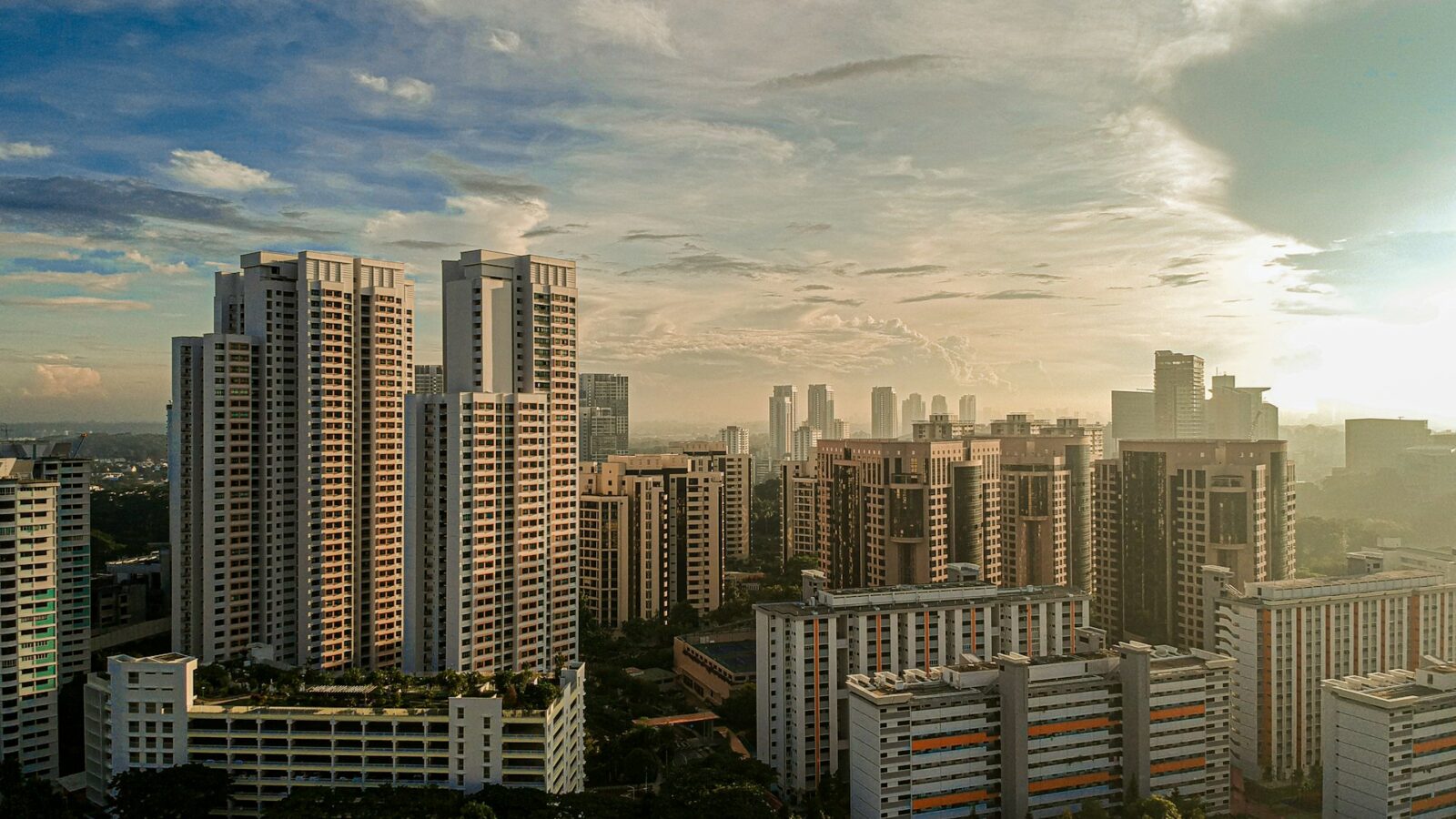
The first step to renting in Singapore is not scrolling through listings but working out which kind of home you are allowed to rent. Housing is split into public HDB flats and private homes (condominiums and landed houses). PRC citizens on a work pass, Student’s Pass or Dependant’s Pass can rent both, but HDB flats come with a quota for foreign tenants, a minimum rental period and occupancy caps, while private homes must be let for at least three months.
On price, HDB’s median figures for Q2 2026 put a whole four-room flat at roughly S$3,000 to S$4,600 a month in most towns, or about RMB 16,000 to 24,000 at the exchange rate of 23 October 2026. Private residential rents rose another 1.3% in Q3 2026. Budget for the deposit, agent commission and stamp duty up front, and verify both the landlord and the agent before signing to avoid rental scams.
HDB flat or private condo: know the rules before viewing
Foreigners can rent HDB flats that the owner has been approved to let, but the rules are stricter than for private homes. The table summarises the official rules as of October 2026.
| Item | HDB flat | Private condo / landed home (URA rules) |
|---|---|---|
| Minimum period | At least 6 months per application; no short-term rental | All occupants must stay at least 3 consecutive months; no daily or weekly letting |
| Maximum approval | Up to 2 years if any tenant is a non-Malaysian non-citizen (PR or foreigner) | No such rule; as agreed in the contract |
| Occupancy cap | Whole flat: 4 for 1–2-room, 6 for 3-room, 8 for 4-room and larger (reverts to 6 for rental periods after 31 December 2028) | Under 90 sqm: up to 6 unrelated persons; 90 sqm or more and registered: up to 8, temporarily from 22 January 2024 to 31 December 2028 |
| Foreign-tenant quota | Whole flats let to non-Malaysian non-citizens: 8% per neighbourhood, 11% per block; bedroom rental not affected | No quota |
| Eligible passes | Employment Pass, S Pass, Work Permit (Work Permit holders in the construction, marine and process sectors must be Malaysian), Student’s Pass, Dependant’s Pass, Long-Term Visit Pass, valid for at least 6 months at application; tourists not allowed | No pass restriction, but no short stays |
| Owner’s duties | Needs HDB’s written approval first; must tell HDB about tenant changes within 7 days | Must respect the minimum stay and occupancy cap |
If the foreign quota in a neighbourhood or block is full, the owner cannot let the whole flat to a Chinese tenant; you can rent a room instead or switch to a private condo. Ask the agent to check the quota before viewing.
Singapore rent prices: HDB rents by town
HDB publishes median monthly rents by town and flat type on the government open-data portal. As of 26 October 2026 the latest figures there are for Q2 2026; Q3 data had not yet been posted. Medians for whole four-room flats in selected towns:
| Town | 3-room (SGD/month) | 4-room (SGD/month) | 4-room in RMB (approx.) |
|---|---|---|---|
| Central Area | 3,300 | 4,600 | ~RMB 24,000 |
| Queenstown | 3,100 | 4,130 | ~RMB 21,500 |
| Clementi | 3,000 | 3,900 | ~RMB 20,300 |
| Toa Payoh | 2,900 | 3,800 | ~RMB 19,800 |
| Ang Mo Kio | 2,800 | 3,500 | ~RMB 18,300 |
| Tampines | 2,800 | 3,500 | ~RMB 18,300 |
| Sengkang | 2,900 | 3,200 | ~RMB 16,700 |
| Yishun | 2,700 | 3,100 | ~RMB 16,200 |
Exchange rate: S$1 ≈ RMB 5.22, a cross rate from the European Central Bank reference rates of 23 October 2026 (EUR/CNY 7.466, EUR/SGD 1.431), for guidance only. There is no official median rent by district for private homes; URA publishes a rental index instead. In Q3 2026 private rents rose 1.3% overall, non-landed rents rose 1.2%, with the Core Central Region down 0.3%, the Rest of Central Region up 1.5% and Outside Central Region up 3.1%. To see actual rents in a specific condo, use URA’s free residential transaction search, which includes private rental contracts.
Rent is only part of the budget; for utilities, internet, transport and food see our guide to the cost of living in Singapore.
Where Chinese residents tend to rent
There are no official statistics on where new Chinese immigrants live. The following is a general description only; let commute and budget decide.
- Chinatown and Outram: plenty of Chinese restaurants and shops, close to the CBD, but rents are among the highest on the island.
- Geylang and Aljunied: many Chinese eateries and small shops, good transport; the median rent for a 3-room flat in Geylang is about S$2,800.
- Clementi and Queenstown: close to the National University of Singapore and the western business districts; popular with students and families accompanying them.
- Jurong West and Boon Lay: near Nanyang Technological University and the Jurong industrial area, with relatively lower rents.
- New towns such as Sengkang, Punggol and Woodlands: many newer flats, suited to families on a tighter budget who accept a longer commute.
To sort out your pass type first, see Singapore visas and passes; for where the jobs are, see our guide to working in Singapore.
The renting process and deposits
- Set budget and typeWhole HDB flat, HDB room or private condo; foreigners check the HDB quota first
- Verify agent and landlordCheck the agent’s name, registration number and mobile number on the CEA Public Register; ask the landlord for proof of ownership and, for HDB, the approval letter
- View in personVisit the home yourself and confirm the person showing it is the registered agent
- Letter of intent and good-faith depositMarket practice is to pay a booking deposit with the letter of intent, which later becomes part of the security deposit
- Sign the lease and pay stamp dutyThe tenant pays stamp duty through IRAS e-Stamping within 14 days of signing
- Handover and address updateCheck the inventory and take photos; work pass holders must update their address with MOM within 5 days
Deposit: Singapore law does not set the deposit amount. Market practice is one month’s rent per year of lease, so one month for a one-year lease and two months for a two-year lease. CEA advises paying the deposit together with the first month’s rent on signing, not paying more than one month’s rent at a time, and paying the landlord directly by a traceable method rather than cash. Whether and how much can be deducted on moving out depends on the contract terms.
Many two-year leases on the market include a “diplomatic clause”, letting the tenant end the lease early after an agreed minimum period and notice if their job moves them out of Singapore. It is not a statutory right, so negotiate it and put it in writing before signing.
Documents you need
| Document | Purpose | Notes |
|---|---|---|
| Passport | Identity check, named in the lease | Should be valid for the whole lease period |
| Pass card or In-Principle Approval (IPA) letter | Proof of lawful stay; required for HDB rental applications | HDB requires at least 6 months’ validity at application |
| Employment contract or letter | Landlord checks ability to pay | Market practice, not a legal requirement |
| Student’s Pass / offer letter | Students renting | HDB also requires 6 months’ pass validity |
| Landlord’s proof of ownership, HDB approval letter | Requested by the tenant to verify the landlord | CEA suggests checking documents such as service and conservancy charge statements or loan statements |
For getting or renewing your passport, see getting a passport before you leave.
Stamp duty, agent commission and other costs
Stamp duty: Under IRAS rules, lease stamp duty is paid by the tenant. Leases with an average annual rent of S$1,000 or less are exempt; for leases of four years or less, duty is 0.4% of the total rent, rounded down to the nearest dollar. For example, a two-year lease at S$3,500 a month totals S$84,000 and attracts S$336 (about RMB 1,750). Leases signed in Singapore must be stamped within 14 days of signing; those signed overseas within 30 days of the document arriving in Singapore. Late payment of up to 3 months costs S$10 or the amount of duty, whichever is higher; beyond 3 months, S$25 or four times the duty, whichever is higher. See the calculation on the IRAS lease stamp duty page.
Agent commission: CEA states that commission is negotiable, should be agreed before signing the estate agency agreement, and should be paid to the agency, not to the agent personally. One agent may not represent both landlord and tenant in the same rental deal, even with both parties’ consent. Rough market practice is half a month’s rent for a one-year lease and one month for two years, and for many higher-rent homes the landlord pays commission and tenants need no agent of their own; this is market practice only, so go by your actual agreement.
Other costs: Tenants usually pay utilities and internet, and regular air-conditioner servicing is often written into the lease. To insure your belongings, see our Singapore insurance guide. Before converting money in China for the deposit and first month’s rent, check the annual purchase quota and purpose declaration in forex and currency limits.
Things to watch: rental scams
The Singapore Police Force reported that from January to October 2024 it received more than 430 reports of rental scams involving fake property agents, with losses of at least S$2.7 million. Most victims found the listings on Facebook, others on Carousell and rental websites.
Typical method: scammers post listings using a real agent’s name but a phone number that differs from the one registered with CEA; on WhatsApp they send fake agent passes and property videos, sometimes send an “assistant” to the viewing, then ask for a deposit by bank transfer or PayNow to “secure” the lease.
- Verify both agent and landlord: check the agent’s registration number and mobile number on the CEA Public Register; if the number does not match, it is very likely a scam.
- The police note that agents may not charge fees to view or rent a property; pay deposits and rent only to the verified landlord’s own account.
- CEA notes that agents may not handle transaction money for HDB leases.
- While still in China, do not pay on the strength of a WeChat group, Xiaohongshu post or video tour; stay in a hotel first, view in person in Singapore, then sign.
- If in doubt, call the ScamShield Helpline 1799 (24/7) or the Police Hotline 1800-255-0000.
Since private homes cannot be let short-term, stay in a licensed hotel for the first weeks; see hotels in Singapore.
Handling tenancy disputes
If there is a dispute over the deposit or repairs, put it in writing first. If that fails, disputes over residential leases of no more than two years can go to the Small Claims Tribunals. The claim limit is S$20,000, or S$30,000 if both parties sign a memorandum of consent, and claims must be filed within two years of the cause of action.
FAQ
Can Chinese citizens rent an HDB flat?
Yes. With an Employment Pass, S Pass, Work Permit, Student’s Pass, Dependant’s Pass or Long-Term Visit Pass valid for at least six months, you can rent an HDB flat that the owner is approved to let. Whole-flat rentals are subject to the foreign quota; rooms are not. Tourists cannot rent HDB flats.
Can I rent for just a month or two?
Generally not through legal channels. The minimum is six months for HDB and three months for private homes; daily or weekly letting breaks the rules. For short stays, use a hotel or accommodation approved for short stays.
Which rental websites are used in Singapore?
Common ones are property portals such as PropertyGuru, 99.co and SRX, plus Carousell and Facebook groups. Most scam cases reported by the police started on social media, so whatever the platform, verify the agent on the CEA register first.
How much is the deposit?
The law does not set it; market practice is one month’s rent per year of lease. Write the refund conditions into the lease and keep photos and the inventory from move-in.
If you plan to stay long-term, compare renting with buying property in Singapore, or look at the rules next door in renting in Malaysia and renting in Japan. For more on life in Singapore, go back to our Singapore relocation guide.
Sources
- HDB – Eligibility to rent out a flat or bedroom (accessed October 2026)
- HDB – Regulations for renting out flats (accessed October 2026)
- HDB via data.gov.sg – Median Rent by Town and Flat Type (accessed October 2026)
- URA – Renting property (minimum stay, occupancy cap) (accessed October 2026)
- URA – Release of 3rd Quarter 2026 real estate statistics (23 Oct 2026) (accessed October 2026)
- URA – Private residential property data services (accessed October 2026)
- IRAS – Stamp duty for renting a property (accessed October 2026)
- IRAS – Who should pay stamp duty (accessed October 2026)
- IRAS – Late payment of stamp duty (accessed October 2026)
- CEA – Consumer guide on residential rental transactions (accessed October 2026)
- CEA – No dual representation (accessed October 2026)
- Singapore Police Force – Advisory on rental scams involving impersonation of property agents (21 Nov 2024) (accessed October 2026)
- MOM – Employment Pass: notify MOM of changes (accessed October 2026)
- Singapore Courts – Criteria for filing a claim at the Small Claims Tribunals (accessed October 2026)
- European Central Bank – Euro foreign exchange reference rates (CNY, SGD), 23 Oct 2026 (accessed October 2026)